
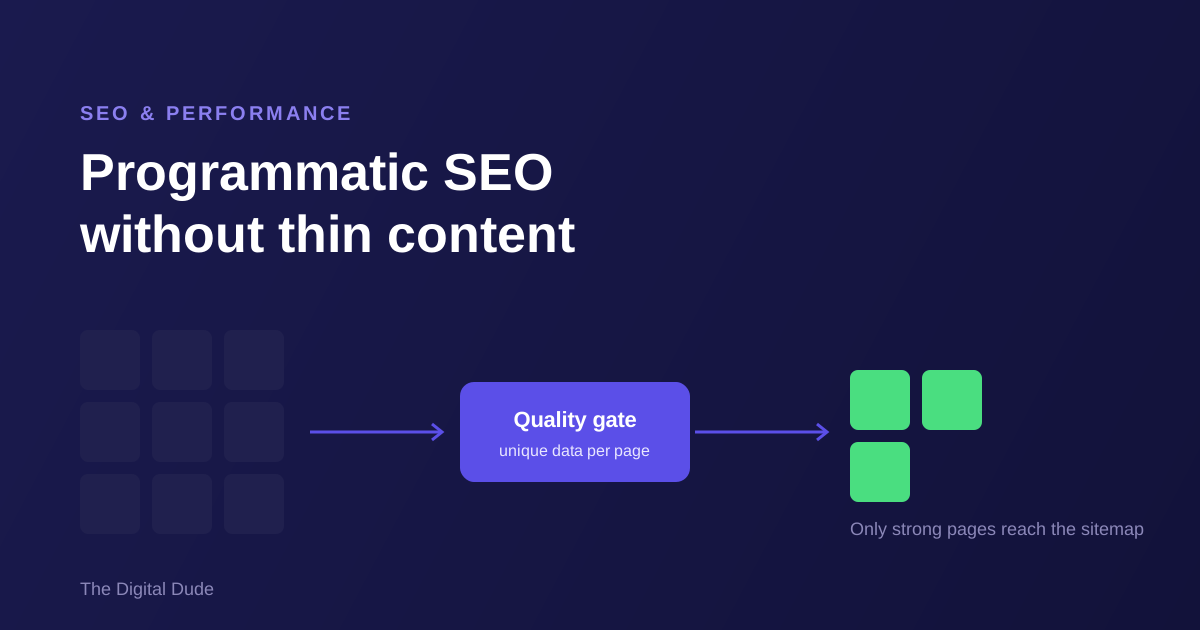
Programmatic SEO can multiply your pages overnight and get most of them ignored. How we generate location, industry and comparison pages, and the quality gate that decides which ones are allowed into the sitemap.
- Core Focus: SEO & Performance
- Estimated Reading Time: 9 min read
- Written by: Tanvir Ahmed Shuvo, Digital Marketing, SEO & Google Ads
What programmatic SEO is, and why most of it fails
Programmatic SEO means generating many search-focused pages from structured data and a template, instead of writing each one by hand. A service business might create a page for every combination of service and city, or service and industry. Done well, it captures the long tail of specific searches that no single article could.
Done badly, it produces hundreds of near-identical pages that Google treats as thin or duplicate content and quietly stops indexing. The difference is almost never the template. It is whether each page has something genuinely its own to say, and whether you stop low-quality pages from being published at all.
We run this on our own site, so what follows is the system we use, not theory, with examples of how each part works. If you are looking for a programmatic SEO agency, this is also how we would approach your build.
The three matrices we generate
Our site builds pages from three data sets:
- Location by service: a page for each service in each city we serve, such as CRM development in Manchester. Each location carries its own local context (regions, areas, local business mix, currency).
- Industry by service: a page for each service applied to each industry, such as a CRM for logistics. Each industry carries its own pain points, regulations, workflows, a recommended technology stack and a linked case study.
- Comparisons: one page for each "custom software vs [product]" decision, with cost models, a feature matrix, migration steps and a calculator.
Together these generate dozens of pages from a few data files, which is the leverage of the approach. But volume is not the point; the data underneath is.
Rule 1: every page needs data a competitor page does not have
A page is worth indexing if a reader gets something specific from it. For each matrix that means:
- Locations: real local context (areas, regional industries, currency, time zone) rather than the city name swapped into a paragraph.
- Industries: the actual compliance rules and workflows of that industry, plus a real project as evidence.
- Comparisons: real pricing models, a worked cost comparison and an honest "when to choose the other option" section.
If you cannot write the unique data for a combination, do not publish that combination. A missing page costs nothing; a thin page can drag down the pages around it.
Rule 2: a quality gate decides what gets indexed
This is the part most people skip. Not every generated page goes into our sitemap. We mark pages as top-tier only when the data behind them is strong, and only those are submitted for indexing. The rest can exist for visitors who reach them through navigation, without asking search engines to treat them as important.
In practice the gate is a short, honest checklist:
- Is there data on this page that is not on a sibling page?
- Does it link to a relevant real project?
- Does it answer a question a person would actually search?
- Would we be comfortable if someone read only this page to judge the company?
If the answer to any of these is no, the page waits.
Rule 3: let editors override the template
Templates are a starting point. For the keywords that matter most, we override the generated page with hand-written content, targeting a specific search phrase with its own headline, description and FAQs. The generated version covers the long tail; the hand-written version wins the head terms. Our pages support a database override for exactly this reason: an editor can improve a page without touching code.
Rule 4: link the matrix to itself and to real proof
Programmatic pages work best as a network:
- Each city page should link to the services available there and to nearby cities.
- Each industry page should link to a matching case study and comparison.
- Blog posts link into the matrix, and the matrix links back to the deeper guides. For example, our CRM cost guide supports the CRM pages, and our Google Ads keyword strategy uses the same pages as landing destinations.
Internal links tell search engines which pages matter and give visitors a route from broad to specific.
Rule 5: measure at the cluster level
Do not judge programmatic SEO page by page. Judge it by cluster:
- How many pages in the cluster are indexed, and how many are "crawled but not indexed"?
- Which pages receive impressions for the target phrase?
- Which pages lead to a booked call, not just a visit?
If a whole cluster is not being indexed, the problem is usually quality or duplication, not the technical setup. Improve the data, then request indexing again.
Common mistakes
- Swapping one word. If two pages differ only by the city name, they are duplicates.
- Publishing everything. Volume without a gate is the fastest route to a site-wide quality problem.
- Forgetting the human. Every page should end in a clear next step for a real buyer.
- Making claims you cannot support. Programmatic pages are especially prone to invented statistics. Only state numbers you can source.
- Set and forget. Prices, regulations and tools change; schedule a review.
A simple process you can copy
- List your services, locations and industries.
- For each combination, ask whether you can add genuinely unique data. Remove the ones you cannot.
- Build the template and the data files.
- Add a quality gate that controls sitemap inclusion.
- Hand-write the pages for your most valuable keywords.
- Add internal links and a relevant case study to every page.
- Review by cluster after 6 to 8 weeks.
Frequently Asked Questions
What is programmatic SEO?
It is the practice of generating many search-targeted pages from structured data and a template, such as one page for each combination of service and city, instead of writing each page manually.
Is programmatic SEO bad for rankings?
Not when each page has unique, useful content. It becomes a problem when pages are near-identical, which search engines treat as thin or duplicate content. A quality gate and genuine per-page data prevent that.
How many programmatic pages should a service business create?
Only as many as you can support with real, distinct data. Dozens of strong pages beat thousands of weak ones.
Should every generated page be in the sitemap?
No. Submit only the pages that meet your quality standard. Others can stay accessible to visitors without being promoted to search engines.
How long does programmatic SEO take to work?
Usually weeks to months. Review at the cluster level after six to eight weeks and improve the data on pages that are not being indexed.
Need this built?
We build and run these systems for our own site and for clients. Talk to us if you want a page matrix designed around your services, with a quality gate from day one.
Tanvir Ahmed Shuvo
Digital Marketing, SEO & Google AdsTanvir leads search and paid-media work at The Digital Dude: technical SEO, programmatic landing pages, Google Ads structure and measurement. He writes about how software businesses turn search demand into qualified leads.
Need expert execution for SEO & Performance?
Whether you are migrating from legacy tooling or architecting custom infrastructure, our UK-based engineers will design a high-converting solution tailored to your workflow.