Software and agency leads are expensive and easy to waste on the wrong searches. A practical way to structure keywords by buying intent, match landing pages to the search, and measure real leads, not clicks.
- Core Focus: Google Ads & PPC
- Estimated Reading Time: 8 min read
- Written by: Tanvir Ahmed Shuvo, Digital Marketing, SEO & Google Ads
Why software lead generation wastes money
Selling custom software on Google Ads is hard because the same few words attract very different people. "Software development" is searched by students, job seekers, people comparing tools, people wanting free templates and, somewhere in there, a business ready to hire. Bid broadly and you pay for all of them.
The fix is not a bigger budget or cleverer bidding. It is deciding, before you spend, which search intents you want to pay for and building each campaign around exactly one of them.
Note: Google Ads data in this article is described as a method. We do not publish keyword volumes or cost-per-click figures here because they change by market and month; pull current figures from Google Keyword Planner for your own country.
Step 1: Sort keywords by buying intent
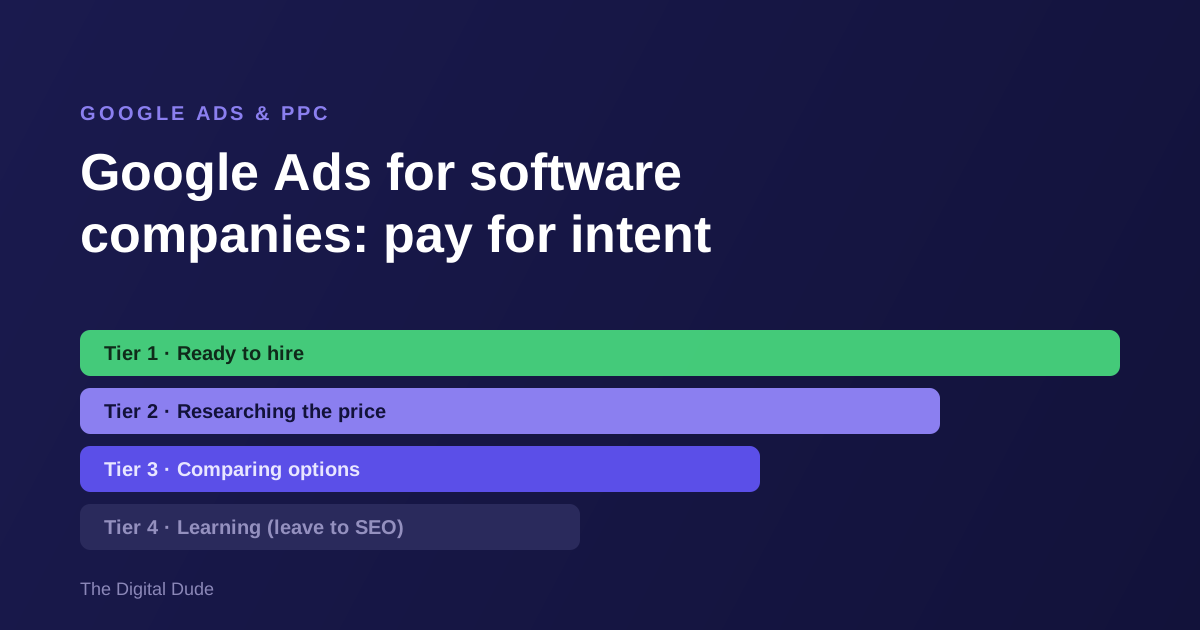
Group every keyword idea into one of four tiers, and decide a budget per tier.
Tier 1: Ready to hire
Searches that name the service and signal a commercial decision: "custom CRM development company", "bespoke software development UK", "marketplace app developers". These are the most valuable and the most competitive. They get the most careful landing pages and the bulk of early budget.
Tier 2: Researching the price
"Custom CRM development cost", "how much does a marketplace app cost". People here are budgeting and often close to a decision. A page that answers the price question honestly, with real ranges, converts better than a generic contact form.
Tier 3: Comparing options
"Salesforce alternative", "HubSpot vs custom CRM", "Shopify alternative". These searchers already know the market and are questioning their current tool. They convert when the page is a real comparison, not a sales pitch.
Tier 4: Learning
"What is a CRM", "how to build an app". High volume, low intent, mostly belongs in organic content, not paid search. Leave these out of Google Ads unless you have a specific reason.
Step 2: Match type follows confidence, not habit
Match types control how closely a search must resemble your keyword. A sensible default for a small budget:
- Exact and phrase match for Tier 1 and Tier 2, where you know the wording and want control.
- Broad match only after you have conversion tracking you trust and enough conversions for the system to learn from. Broad match with weak tracking teaches Google to find cheap, low-quality clicks.
- Always review the search terms report. It shows the real queries that triggered your ads and is the only honest basis for adding negative keywords. Add negatives from what you actually see, never from a generic list, because a negative that looks harmless can block a customer you wanted.
Step 3: One intent, one landing page
The most common waste in agency advertising is sending every ad to the home page. Each campaign should land on a page that finishes the sentence the searcher started.
- A "custom CRM development cost" ad lands on a CRM cost page with real ranges.
- A "Salesforce alternative" ad lands on a Salesforce comparison.
- A "marketplace app developers" ad lands on a marketplace page with a relevant case study.
On this site that means our CRM cost guide, our comparison pages and our case studies. Message match raises quality score, which lowers cost per click and raises conversion rate, both at once.
Step 4: Measure leads, not clicks
Clicks and form fills are not the goal. A qualified conversation is.
- Track the form and the booking as separate conversions. A booked discovery call is worth more than a contact-form message.
- Use Enhanced Conversions so conversions are matched more reliably despite browser privacy limits.
- Import offline conversions from your CRM. When a lead later becomes a paying client, send that back to Google Ads. Optimising towards revenue, not enquiries, is how you stop paying for tyre-kickers.
- Record the source in the lead. Use the click ID and campaign on every enquiry so sales can see which searches produce clients.
If you cannot yet do step 3, start with step 1 and a monthly manual review of which enquiries became clients.
Step 5: Make paid and organic work together
Paid search is a fast test, organic is a long-term asset. Use them together:
- Run paid on a keyword for a few weeks. If it produces qualified leads, build or improve the organic page for it.
- Use the paid search terms report as a free keyword research tool for blog and landing page ideas.
- Move budget away from keywords where your organic page already ranks well and converts.
We apply the same thinking to scaled location and industry pages, which we explain in programmatic SEO for service businesses.
A starting structure for a small budget
- Campaign 1: Ready to hire (exact and phrase), one ad group per service.
- Campaign 2: Price research, pointing at the cost guide.
- Campaign 3: Comparisons, one ad group per competitor.
- Skip Tier 4 entirely.
- Review the search terms report weekly for the first month, then fortnightly.
- Judge success on booked calls and later on closed work, not clicks.
Frequently Asked Questions
Is Google Ads worth it for a software development company?
It can be, if you target buying-intent searches and measure qualified leads. It is a poor fit if you bid on broad terms like "software development" with no conversion tracking, because you will pay for researchers, students and job seekers.
Which keywords should a software agency target first?
Start with Tier 1 and Tier 2 intent: the service plus a commercial word, such as "custom CRM development company" or "custom CRM development cost", then add comparison searches like "Salesforce alternative". Use Google Keyword Planner to check current volumes for your country.
Should I use broad match?
Only when your conversion tracking is reliable and you have enough conversions for the system to learn from. Until then, exact and phrase match give you control.
How do I find negative keywords?
From the search terms report of your own campaigns. Review the actual queries that triggered ads and block only the ones that clearly will never convert. Avoid copying generic lists, which can block valuable searches.
How long before Google Ads produces leads?
Expect a learning period of several weeks. Judge a campaign after enough clicks and conversions to be meaningful, and avoid changing bids and budgets daily.
Want help with this?
If you want this structure built for your own software or agency business, get in touch. We will review your tracking first, because that is where most accounts lose money.
Tanvir Ahmed Shuvo
Digital Marketing, SEO & Google AdsTanvir leads search and paid-media work at The Digital Dude: technical SEO, programmatic landing pages, Google Ads structure and measurement. He writes about how software businesses turn search demand into qualified leads.
Need expert execution for Google Ads & PPC?
Whether you are migrating from legacy tooling or architecting custom infrastructure, our UK-based engineers will design a high-converting solution tailored to your workflow.