Published UK guides quote anything from £15,000 to £200,000+ for a custom CRM. Here is what actually drives the price, the bands we scope against, and the running costs most guides leave out.
- Core Focus: CRM Development
- Estimated Reading Time: 9 min read
- Written by: Farhad Hossain, Founder & Solutions Architect
The short answer
Search for custom CRM development cost, or for what a bespoke CRM system costs, in the UK and you will find ranges so wide they are almost useless: some agency guides start around £15,000 and run past £200,000 for enterprise builds, while others quote a small-business CRM at £10,000 to £25,000. Most of those pages are written by agencies selling the work, so treat the numbers as marketing, not benchmarks.
For a focused, single-business CRM (a pipeline, role-based access, a few integrations and reporting), the bands we scope against are roughly $5,500 to $12,000 and 4 to 6 weeks, as set out in our custom software cost guide. The honest version of "it depends" is below: what pushes a custom CRM to the bottom or the top of a range, so you can place your own project before you speak to anyone.
What actually drives the price of a custom CRM
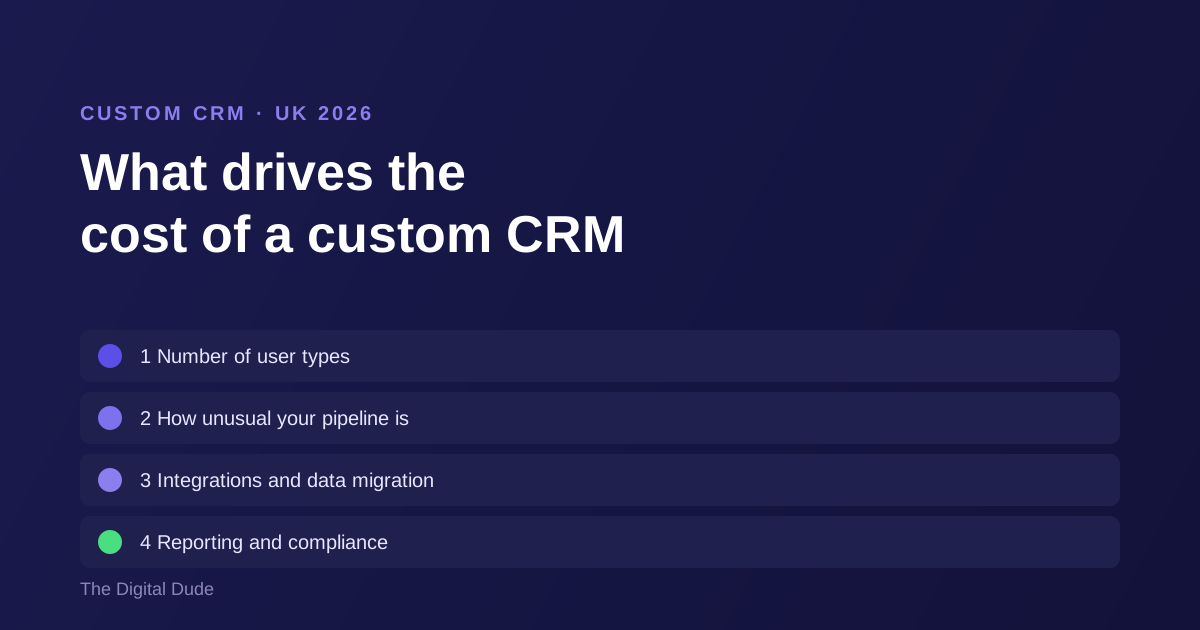
Price is a function of how many different things the system has to do, not how many screens it has. Five factors explain nearly all of the variation.
1. How many types of user
A CRM used by one sales team is one product. A CRM with an admin, an internal team, external agencies, field staff and customers each seeing different data is five products sharing one database. Every additional user type needs its own permissions, views and testing. This is the single biggest cost driver, and it is why role-based access control deserves a proper conversation early.
2. How unusual your pipeline is
If your sales process really is lead, qualified, proposal, won, you can adapt almost any tool. The case for building starts when the workflow is specific: compliance deadlines, dispatch, multi-step approvals, quotes that depend on measured data. The more your process differs from a standard sales funnel, the more a custom build earns its cost, and the more design time it needs.
3. Integrations
Each integration (accounting, payments, email, WhatsApp, SMS, calendars) is its own mini-project with authentication, error handling and testing. A CRM that talks to one system costs noticeably less than one that synchronises with five. Ask for each integration to be priced separately.
4. Data migration
Moving years of contacts and deals out of spreadsheets or another CRM means cleaning, de-duplicating and mapping fields. Messy source data is the most common reason a fixed quote grows. A one-hour look at your export before scoping saves weeks later.
5. Reporting and compliance
Live dashboards, per-agent performance and audit trails add real work. So does anything touching regulated data. If you hold personal data, UK GDPR affects how you store, export and erase it, and building that in from the start is far cheaper than retrofitting it.
Three realistic bands
These are guides, not quotes. Your own number depends on the five factors above.
- Focused CRM (one team, one pipeline, one or two integrations): the low end of the band, usually 4 weeks. A custom pipeline, reminders, simple reporting and a clean import of your existing contacts.
- Multi-role CRM (several user types, portals, quotes and invoices): the middle to upper part of the band, usually 5 to 6 weeks. Separate portals for staff, partners and customers, with documents and notifications.
- Operational platform (CRM plus dispatch, scheduling, payments or compliance): above the standard band. At this point it is closer to a bespoke operations system, and it should be scoped in phases with a working release at each step.
The running costs most guides leave out
A build price is not the whole cost. Budget for these from day one:
- Hosting and database: for a modern serverless stack this is typically in the region of $50 to $200 a month for a small team, rising with traffic and storage.
- Maintenance and iteration: plan on roughly 10 to 15 per cent of the build cost a year for security updates, dependency upgrades and the small changes every live system accumulates.
- Third-party usage: SMS, email sending and payment processing are billed by use, not by seat.
- Your own time: someone on your side needs a few hours a week during the build to answer questions and test. A build starved of that time takes longer and costs more.
What you do not pay is a per-user licence. That is the structural difference from packaged CRMs, and it is why the comparison tilts towards custom as headcount grows. We work through the numbers for specific products in our guides to custom CRM vs Salesforce, vs HubSpot and vs Zoho.
When buying off-the-shelf is the cheaper answer
A custom CRM is not always right, and it is worth saying so plainly. Buy a packaged CRM if:
- you have a standard sales funnel and fewer than about ten users;
- you need to be working by next week;
- you rely on a large ecosystem of ready-made integrations;
- you do not yet know how your process works and need to learn by using something.
The honest test is whether you are bending your process to fit the tool, or the tool to fit the process. Many teams start on a packaged tool, hit the limit, and build only when the workarounds cost more than the build would. We cover that decision in off-the-shelf vs custom CRM.
How to keep the cost down without cutting corners
- Start with one workflow. Build the pipeline that makes money first; add portals and reports once it is in daily use.
- Decide what is not in version one. A written "later" list is the cheapest scope control there is.
- Fix the price per milestone. Fixed-scope milestones with a working demo each week keep surprises small.
- Own the code. Make sure the contract gives you the source code and the database. It is what makes the asset yours rather than rented.
- Bring your data early. Share a real export in week one, not week five.
Frequently Asked Questions
How much does a custom CRM cost in the UK?
It depends mainly on the number of user types, how unusual your workflow is, integrations and data migration. A focused single-business CRM is roughly $5,500 to $12,000 on our scoping bands, while published UK agency guides quote anything from about £10,000 to well over £100,000. Treat any figure given before a scoping conversation as an estimate.
How long does it take to build a custom CRM?
A focused CRM typically takes 4 to 6 weeks to a first live release. Multi-role platforms with several integrations take longer and are best delivered in phases, with something usable at the end of each one.
Is a custom CRM cheaper than Salesforce or HubSpot?
Over a few years and a growing team, often yes, because there are no per-seat licences. For a small team with a standard funnel, a packaged CRM is usually cheaper and faster to start. The break-even depends on headcount and how far your process differs from the standard one.
What does a custom CRM cost to run each year?
Expect hosting and database costs, third-party usage fees, and roughly 10 to 15 per cent of the build cost a year for maintenance and improvements. There is no per-user licence fee.
Do I own the code of a custom CRM?
You should. Insist that the contract transfers the source code and the database to you, so you can host it, change it or move agency without starting again.
Next step
If you want a number for your own workflow rather than a range, book a 30-minute discovery call. Bring one real example of how a lead moves through your business today and we will tell you honestly whether custom, packaged, or a hybrid is the right answer.
Farhad Hossain
Founder & Solutions ArchitectFarhad founded The Digital Dude and scopes and architects every client system: data models, access control and security first, then the build. He writes about custom CRMs, marketplaces, AI features and the real cost and trade-offs of building software.
Need expert execution for CRM Development?
Whether you are migrating from legacy tooling or architecting custom infrastructure, our UK-based engineers will design a high-converting solution tailored to your workflow.