
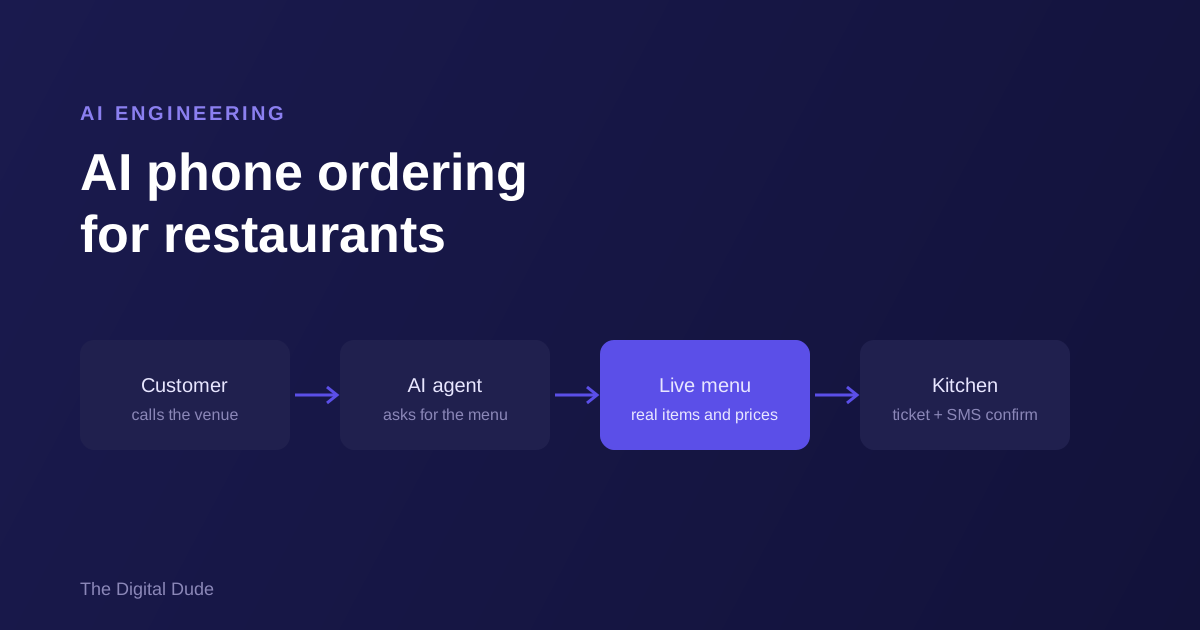
Restaurants lose orders when the phone rings during service. We built an AI ordering platform to fix that. Here is how it works, what surprised us, and when buying a ready-made tool is the smarter call.
- Core Focus: AI Engineering
- Estimated Reading Time: 9 min read
- Written by: Farhad Hossain, Founder & Solutions Architect
The problem is the phone, not the menu
During a dinner rush, nobody can answer the phone. The person who would is plating food or serving tables, so the call goes to voicemail and the customer orders from someone else. Delivery apps help, but they take a commission on every order, so many restaurants still want direct phone orders and have no good way to take them at peak time.
An AI phone ordering system for restaurants answers every call, takes the order against the live menu, and sends the ticket to the kitchen. The idea is simple. Doing it reliably is not, and the difference between a demo and something a restaurant trusts on a Friday night is where almost all of the engineering sits.
We built an ordering platform of this kind for the Australian market and are running it with a pilot restaurant. This article shares what that taught us, so you can decide whether to build, buy, or do neither.
How AI phone ordering actually works
A good system is a pipeline of small, checkable steps rather than one clever model:
- Answer and disclose. The agent picks up, says it is an AI assistant and that the call may be recorded. This is good practice everywhere and, depending on where you operate, a legal requirement.
- Understand the order. Speech is turned into text, and the agent maps what the caller says ("a large margherita and two cokes") to real menu items.
- Check against the live menu. The model never invents items or prices. It calls tools, such as "get the menu" or "add this item", and the system answers from your actual data.
- Read the order back. The agent repeats the full order and total before placing it.
- Place the order. The order is written to the database, the kitchen is notified, and the customer receives a text confirmation.
- Escalate if nobody notices. If the tablet is not acknowledged, staff get a text, and as a last resort the system calls back.
The key design decision is step 3. A voice model that "remembers" the menu will eventually quote a price that is wrong. A model that must ask your system for every price cannot.
What surprised us building it
Systems you do not control become the project
Our first design ran its own telephony and voice pipeline. We later moved to using GoHighLevel as the system of record for voice, SMS and order automation, mirroring state into our own database. That removed a large amount of infrastructure, but it also meant the reliability of the whole product depended on what the third-party API actually does, not what its documentation implies. Some things we assumed were available, such as call transcripts through the API, were not. We now treat every integration as "unverified until tested against the live service", and we keep a written audit of what is confirmed and what is a guess.
The hardest bugs are in the money and the clock
Prices stored GST-inclusive, tax shown on receipts, pickup times in the restaurant's time zone, and payment links that must never be fired by accident during testing. None of this is glamorous and all of it matters. A payment link that texts a real customer from a test run is a bad day, so anything with real-world side effects sits behind an explicit switch.
Multi-tenant means isolation from day one
If you want to sell the system to more than one restaurant, each venue's data must be walled off at the database level. We use row-level security on every tenant table from the first migration, so a coding mistake in one screen cannot expose another restaurant's orders. Retrofitting that later is painful.
Escalation is the product
The AI is the easy part to demo. The part owners care about is "what happens when it does not work": staff alerts, a human hand-off, hours-closed handling, and a call log with recordings so a disputed order can be checked. A system that fails safely is worth more than one that is occasionally brilliant.
Build vs buy: an honest comparison
Ready-made products exist. Flipdish, for example, has reported that restaurants using its AI Phone Agent in the UK and Ireland have placed over 10,000 orders worth more than £230,000. Those are the company's own figures and have not been independently checked, but they show the category is real and moving.
Buy a ready-made product if:
- you run one or a few restaurants and just want missed calls answered;
- you already use a point-of-sale or ordering platform that offers it;
- you can accept the vendor's pricing, menu handling and roadmap.
Build (or commission) your own if:
- you want to resell the service to many venues under your own brand;
- you need to connect to systems a vendor does not support;
- the order data is a strategic asset you want to own;
- you need local rules, languages or pricing that products do not handle.
For a single restaurant, building almost never pays back. For a business that wants to be the platform, it can.
Questions to ask any vendor, including us
- Does the agent ever state a price or item it did not fetch from my menu?
- What happens if the kitchen tablet is not acknowledged?
- Can I listen to the recording of any call?
- Where is my data stored, and can I export it?
- Who is responsible if a payment link or text goes to the wrong person?
- What does it cost per call, and what happens at 3x my normal volume?
Frequently Asked Questions
How does AI phone ordering work for restaurants?
An AI agent answers the call, takes the order conversationally, checks every item and price against the restaurant's live menu through tool calls, reads the order back, then sends the ticket to the kitchen and a confirmation text to the customer.
Is AI phone ordering accurate enough for a busy restaurant?
Accuracy depends on how the system is built, not only on the voice model. Systems that fetch items and prices from your menu, confirm the order aloud and hand off to a person after repeated misunderstandings perform far better than ones that rely on the model's memory. Test with real accents, background noise and unusual menu items before going live.
Do I have to tell callers it is an AI?
Plan on it. Disclosing the AI and any call recording at the start of the call is good practice and, in many places, a legal requirement. Check the rules where you operate.
How much does it cost to build an AI phone ordering system?
It varies with the number of venues, integrations and the voice platform. A single-venue tool is far cheaper than a multi-tenant product with billing, admin and escalation. We scope it in phases so you can launch with one pilot restaurant before investing in the full platform.
Should a single restaurant build its own?
Almost never. Use an existing product. Building makes sense when you are creating a business that serves many restaurants.
Talk to us
If you are weighing up AI ordering for a hospitality business or a platform, see how we approached it in our AI restaurant ordering case study, or book a discovery call and we will tell you honestly whether to buy or build.
Farhad Hossain
Founder & Solutions ArchitectFarhad founded The Digital Dude and scopes and architects every client system: data models, access control and security first, then the build. He writes about custom CRMs, marketplaces, AI features and the real cost and trade-offs of building software.
Need expert execution for AI Engineering?
Whether you are migrating from legacy tooling or architecting custom infrastructure, our UK-based engineers will design a high-converting solution tailored to your workflow.